A.2 SL/HL Concept 3 of 5

Friction and Normal Force

Part of A.2 Forces and Momentum · Unit A — IB Physics 2023

3 Lesson 3 of 5 · A.2 Forces and Momentum
Friction and Normal Force
Why a box refuses to move until you push hard enough — and why it suddenly gets easier once it does.

🎯 Hook – the step you never think about

Stand up and take one step. Your shoe pushes backwards on the floor; friction pushes your shoe forwards with an equal force, and that forward push is the only thing moving you. Take friction away — spill oil, or step onto wet ice — and the push still happens, but you go nowhere. Friction is not the enemy of motion; on land it is the source of it.
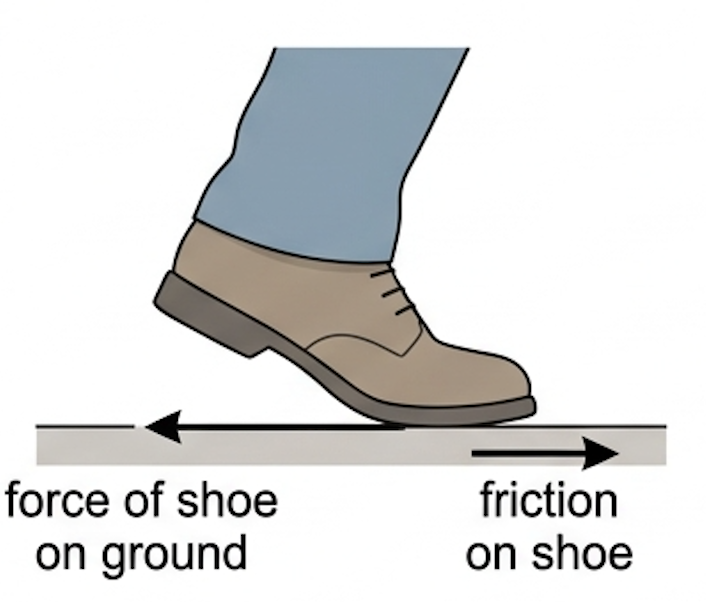
Shoe pushing backwards on the ground with an equal frictional force pushing the shoe forwards
Fig 1 — The shoe pushes back on the ground; friction on the shoe points forwards. Vertical forces are not shown.
💡 Diagnostic question (think – then read on) — A heavy crate sits on a floor and you push it horizontally with 40 N. It does not move. How big is the frictional force on it? Exactly 40 N. Static friction is not a fixed number: it adjusts itself to match whatever you apply, up to a maximum.

📐 Normal force, static friction and dynamic friction

Surface friction is the collection of forces acting parallel to the plane of contact between two surfaces, opposing relative motion or attempted motion. It always acts alongside the normal contact force \(F_{\text{N}}\), which acts perpendicular to that same surface.

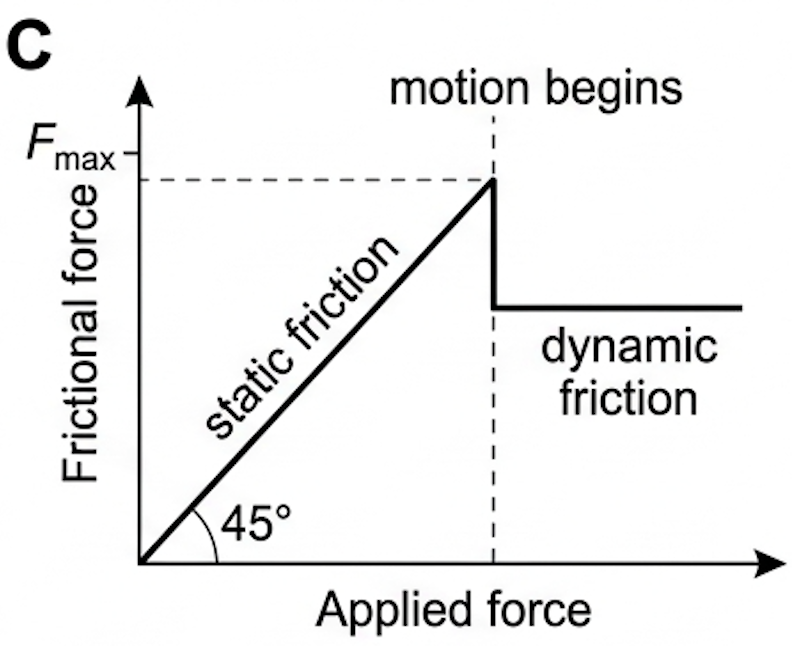
While the object is stationary the friction is static friction. It grows to match the applied force up to a limiting value \(F_{\text{max}}\). Once the object slides, the friction drops slightly and becomes dynamic friction, which is roughly constant regardless of speed.

Static friction (body at rest) $$F_{\text{f}} \le \mu_{\text{s}} F_{\text{N}}$$
Dynamic friction (body sliding) $$F_{\text{f}} = \mu_{\text{d}} F_{\text{N}}$$

The coefficient of friction \(\mu\) has no units — it is a ratio of two forces, and it describes the pair of surfaces, not either surface alone. For most pairs \(\mu_{\text{d}} < \mu_{\text{s}}\), which is why a stuck box lurches forward the moment it breaks free.
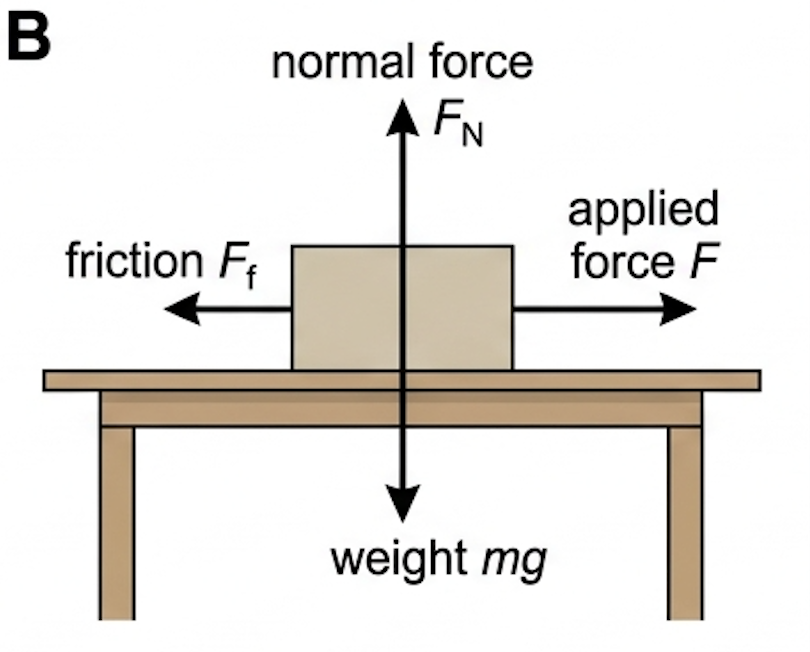
Free body diagram of a block on a horizontal surface with weight, normal force, applied pull and friction
Fig 2 — On a horizontal surface with no vertical pull, \(F_{\text{N}} = mg\). Friction acts parallel to the surface, opposite the (attempted) motion.
SurfacesApproximate \(\mu_{\text{s}}\)
Steel on ice0.03
Wood on concrete0.3
Rubber tyre on wet road0.5
Rubber tyre on dry road0.8
Glass on glass0.9
⚠️ Contact area does not appear in either equation. Doubling the contact area halves the force pressing on each square centimetre, so the total friction stays about the same.

📈 Graphs every examiner uses

Graph typeAxes (X, Y)ShapeWhat to read
Friction vs applied forceApplied force \(F\), frictional force \(F_{\text{f}}\)Straight line at 45° up to \(F_{\text{max}}\), then a drop to a lower horizontal linePeak value = \(F_{\text{max}} = \mu_{\text{s}}F_{\text{N}}\); the flat part = dynamic friction
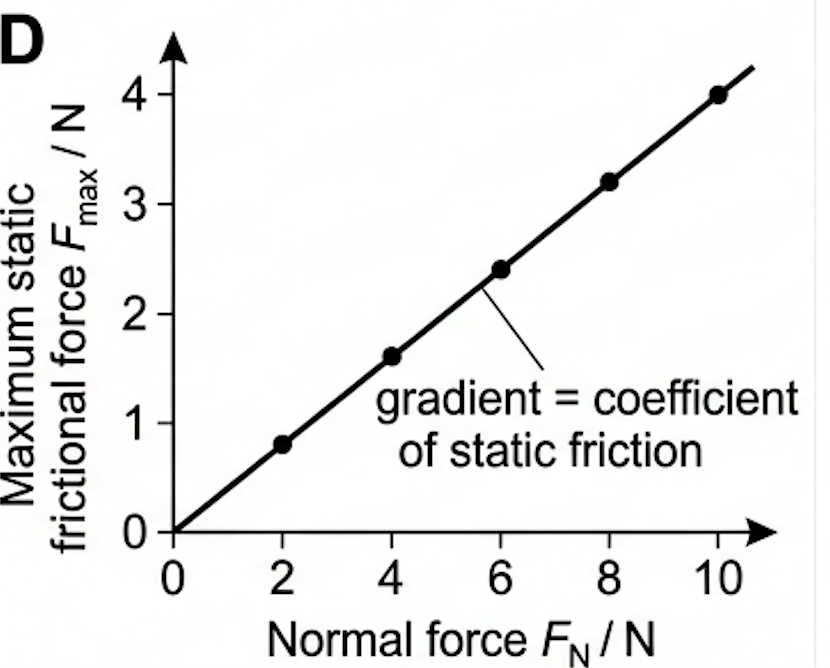
Maximum static friction vs normal force\(F_{\text{N}}\), \(F_{\text{max}}\)Straight line through the originGradient = \(\mu_{\text{s}}\) (no units)
Dynamic friction vs speedSpeed \(v\), \(F_{\text{f}}\)Horizontal lineDynamic friction is independent of speed
Graph of frictional force against applied force showing static region, peak and lower constant dynamic region
Fig 3 — Friction matches the applied force until motion begins, then settles at a lower constant value.
Graph of maximum static frictional force against normal force, a straight line through the origin
Fig 4 — \(F_{\text{max}} \propto F_{\text{N}}\); the gradient is \(\mu_{\text{s}}\).
💡 Read the gradient off a large triangle, not a single point. A line through \((10.0\,\text{N},\,4.0\,\text{N})\) gives \(\mu_{\text{s}} = 0.40\).

✍️ Worked example – shifting a wooden crate
1
Identify: A 54 kg wooden box rests on a horizontal concrete floor. We want (a) the minimum horizontal force to start it sliding, and (b) the coefficient of dynamic friction if 120 N then keeps it moving at constant speed. Both parts need \(F_{\text{N}}\) first.
2
Data: \(m = 54\ \text{kg}\), \(g = 9.8\ \text{m s}^{-2}\), \(\mu_{\text{s}} = 0.3\) (wood on concrete). Horizontal floor, no vertical pull, so \(F_{\text{N}} = mg = 54 \times 9.8 = 529\ \text{N}\).
3
Equation: \(F_{\text{max}} = \mu_{\text{s}}F_{\text{N}} = 0.3 \times 529 = 159\ \text{N}\). For part (b), constant speed means the applied force equals dynamic friction: \(\mu_{\text{d}} = F_{\text{f}}/F_{\text{N}} = 120/529\).
4
Answer: About \(1.6 \times 10^{2}\ \text{N}\) is needed to break it free, and \(\mu_{\text{d}} = 0.23\). Since \(\mu_{\text{d}} < \mu_{\text{s}}\), any force above 120 N leaves a resultant force and the box accelerates.
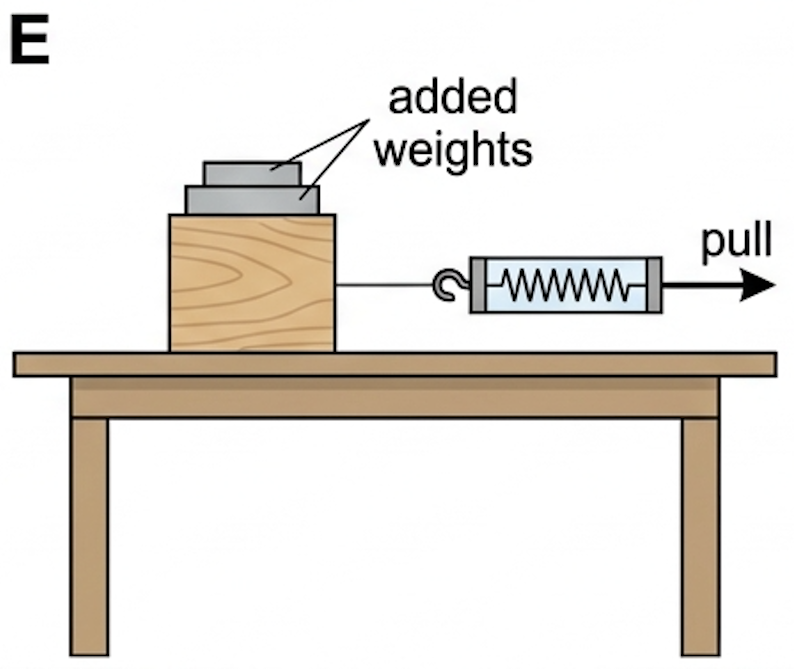
Laboratory setup: wooden block pulled by a force meter across a table with weights stacked on top
Fig 5 — The standard lab arrangement: a force meter pulls the block while added weights vary \(F_{\text{N}}\).
✓ Quote \(\mu\) to 2 significant figures and never give it a unit — a unit costs the mark.

🔧 Real-world: tyres and stopping distance

Braking relies entirely on friction between tyre and road. Dry asphalt gives \(\mu_{\text{s}} \approx 0.8\); wet asphalt about 0.5. Tread grooves exist to disperse water so the rubber can still touch the road — a smooth tyre actually grips better when dry, which is why racing slicks are illegal in the rain.

✓ Examiner tip: maximum braking uses static friction — the tyre rolls without slipping. A skidding tyre uses the smaller dynamic coefficient, so it stops in a longer distance.

🚀 HL Extension – viscous drag and Stokes's law

Fluids resist motion too. For a small smooth sphere moving slowly enough to avoid turbulence, the drag force is

$$F_{\text{d}} = 6\pi\eta r v$$

where \(\eta\) is the viscosity in Pa s. At terminal speed the sphere is in equilibrium: \(F_{\text{d}} + F_{\text{b}} = mg\).
Challenge: A steel ball of radius 1.0 mm falls at 0.050 m s⁻¹ through oil of viscosity 0.70 Pa s. Find the viscous drag. (Answer: \(6\pi \times 0.70 \times 1.0\times10^{-3} \times 0.050 = 6.6\times10^{-4}\ \text{N}\))
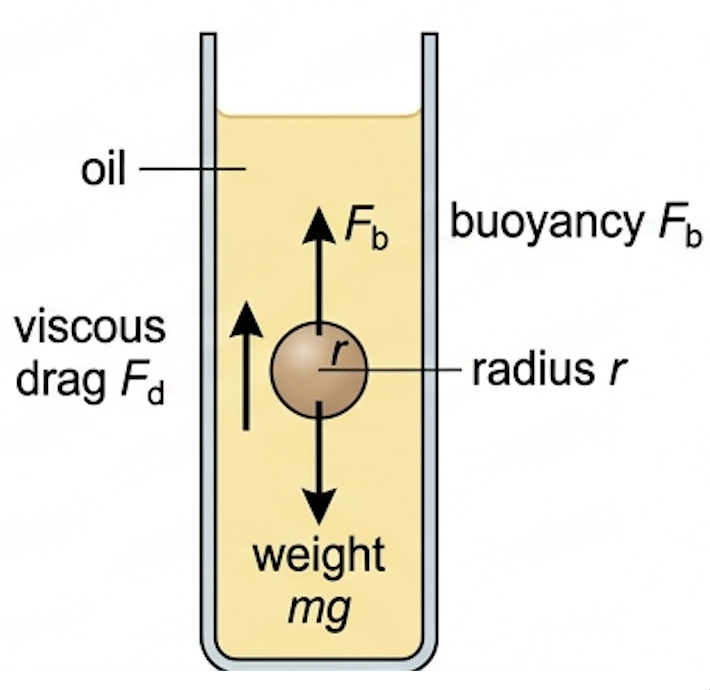
Sphere falling through oil with viscous drag and buoyancy upwards and weight downwards
Fig 6 — At terminal speed the three forces balance.

⚠️ Trap corner – common mistakes

MisconceptionCorrect view
A bigger contact area means more frictionArea cancels out. Double the area and the force per unit area halves, leaving \(F_{\text{f}}\) unchanged.
Static friction always equals \(\mu_{\text{s}}F_{\text{N}}\)That is only its maximum. Below it, static friction equals the applied force exactly: \(F_{\text{f}} \le \mu_{\text{s}}F_{\text{N}}\).
\(F_{\text{N}}\) is always equal to \(mg\)Only on a horizontal surface with no other vertical force. On an incline \(F_{\text{N}} = mg\cos\theta\); pushing down at an angle increases it.
Friction always slows things downFriction opposes relative sliding. For walking, driving and cornering it is the force that produces the acceleration.
Dynamic friction grows with speedIt is taken as constant with speed. Speed-dependent resistance is fluid drag, not surface friction.
⚠️ Most common slip: using \(\mu_{\text{s}}\) when the body is already sliding. Read the question — "just about to move" means static; "moving at constant speed" means dynamic.
F_f ≤ μ_s F_N F_f = μ_d F_N μ has no units μ_d < μ_s F_N = mg (horizontal only) F_d = 6πηrv (HL)
Practice check — multiple choice
1. A 5.0 kg block sits on a horizontal floor with \(\mu_{\text{s}} = 0.40\). A horizontal force of 12 N is applied and the block does not move. What is the frictional force on the block?
A 0 N
B 12 N
C 20 N
D 49 N
2. A graph of maximum static frictional force against normal force is a straight line through the origin. Its gradient represents
A the weight of the block, in N
B the contact area, in m²
C the coefficient of static friction, with no unit
D the coefficient of static friction, in N kg⁻¹
3. A block slides across a bench and is then turned onto a face of half the area before being slid again with the same normal force. The dynamic frictional force
A halves
B doubles
C stays approximately the same
D falls to zero
4. A 2.0 kg block is pulled along a horizontal surface at constant velocity by a horizontal force of 4.9 N. The coefficient of dynamic friction is
A 0.10
B 0.25
C 0.50
D 2.5
Practice check — fill in the blanks

Complete the statements:

The force acting perpendicular to the surfaces in contact is called the force. While a body is still at rest, the friction acting on it is called friction, and once it slides the friction is called friction. The coefficient of friction has units.
Exam‑style questions
Exam question · State / Explain
(a) State what is meant by the coefficient of static friction. [1]
(b) Explain why a car's braking distance is longer on a wet road than on a dry one. [3]
4 marks
(a) ✓ The ratio of the maximum frictional force to the normal contact force between two surfaces just before sliding begins.
(b) ✓ Water between tyre and road reduces the coefficient of friction. ✓ The maximum frictional force \(\mu F_{\text{N}}\) is therefore smaller. ✓ Smaller decelerating force means a smaller deceleration, so the car travels further before stopping.
Exam question · Calculate
A crate of mass 25 kg rests on a horizontal floor. The coefficient of static friction between crate and floor is 0.45 and the coefficient of dynamic friction is 0.30.
(a) Calculate the minimum horizontal force needed to start the crate moving. [2]
(b) The crate is then pushed with a constant horizontal force of 110 N. Calculate its acceleration. [3]
5 marks
(a) ✓ \(F_{\text{N}} = mg = 25 \times 9.8 = 245\ \text{N}\). ✓ \(F_{\text{max}} = 0.45 \times 245 = 110\ \text{N}\).
(b) ✓ Now sliding, so \(F_{\text{f}} = 0.30 \times 245 = 73.5\ \text{N}\). ✓ Resultant \(= 110 - 73.5 = 36.5\ \text{N}\). ✓ \(a = F/m = 36.5/25 = 1.5\ \text{m s}^{-2}\).
Exam question · Sketch / Discuss
A student slowly increases the horizontal pull on a block resting on a bench until the block moves off and accelerates.
(a) Sketch a graph of the frictional force on the block against the applied force, labelling \(F_{\text{max}}\). [3]
(b) Discuss one reason why the value of \(\mu_{\text{s}}\) obtained from this experiment may be unreliable. [2]
5 marks
(a) ✓ Straight line of gradient 1 from the origin while the block is stationary. ✓ Peak labelled \(F_{\text{max}}\) where motion begins. ✓ A drop to a lower horizontal line for dynamic friction.
(b) ✓ The pull is increased by hand, so the peak reading is hard to catch and is easily overshot or missed. ✓ Surface condition varies across the bench (dust, wear, uneven contact), so repeats scatter and \(\mu_{\text{s}}\) is not a single fixed value.
Score: 0 pts