How do we describe motion precisely? Learn the difference between distance and displacement, master scalars vs vectors, and see how acceleration links changes in velocity to time.
🚗 Hook – The New York–Boston paradox
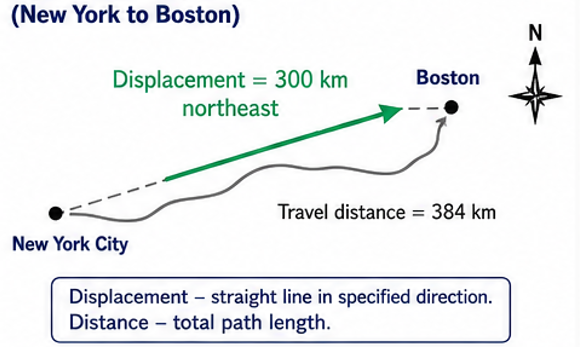
A family drives from New York City to Boston. Their car’s odometer reads 384 km. However, a straight line on a map shows only 300 km. Which number is the distance travelled, and which is the displacement? How can two different measurements describe the same trip? Understanding this distinction is the first step to analysing motion in physics.
Fig 1 — Travel distance (curved road) 384 km vs displacement (straight arrow) 300 km northeast.
💡 Diagnostic question (think – then click) — If a runner completes one lap of a 400 m track and returns to the start, what are the distance and displacement? Answer: distance = 400 m, displacement = 0 m (because final position = initial position).
📐 Scalars, vectors, and the difference between distance and displacement
Scalars have only magnitude (size). Examples: mass, time, speed, distance. Vectors have both magnitude and direction. Examples: displacement, velocity, acceleration, force.
Distance is the total length of a path travelled – a scalar. Displacement is the straight‑line distance from a reference point in a specified direction – a vector.
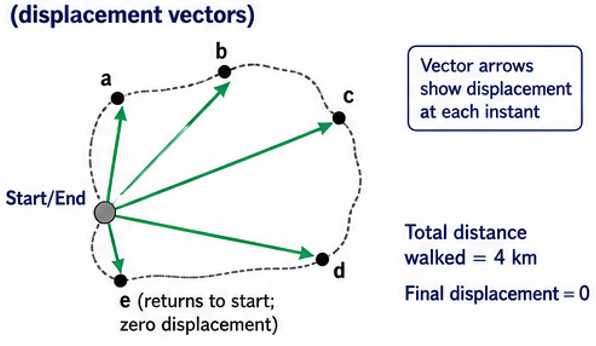
Fig 2 — A 4 km walk returns to start → total distance = 4 km, final displacement = 0.
⏱️ Speed, velocity & measuring motion
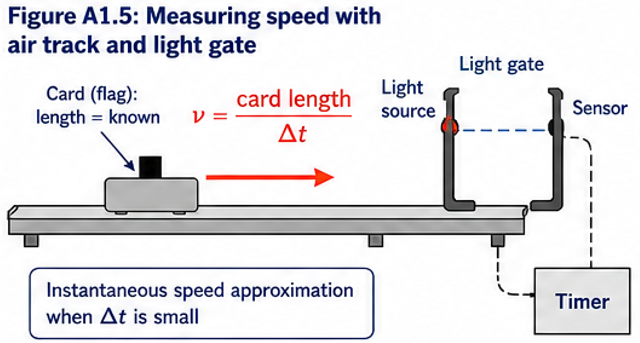
Speed = distance / time (scalar). Velocity = displacement / time (vector). Average values are over a finite time; instantaneous values are measured over an infinitesimally small interval (e.g., from a light gate).
Average speed & average velocity
$$v_{\text{avg speed}} = \frac{\text{distance}}{\Delta t} \qquad \vec{v}_{\text{avg}} = \frac{\Delta \vec{s}}{\Delta t}$$
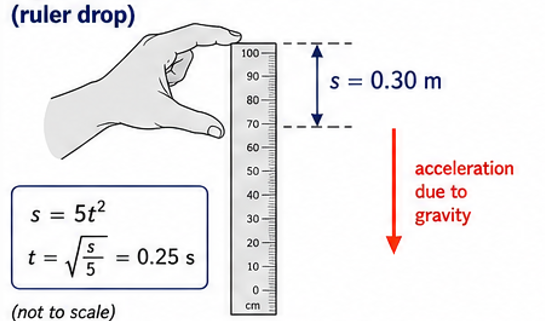
Human reaction times (~0.25 s) introduce uncertainty when using stopwatches. Light gates provide precise timing by detecting when a beam is interrupted.
Fig 3 — Measuring reaction time: catch a falling ruler; distance fallen gives time from \(s = 5t^2\).
Fig 4 — Air track & light gate: speed = card length / time through gate (instantaneous approximation).
📈 Acceleration – changing velocity
Acceleration is the rate of change of velocity. It is a vector. Speeding up, slowing down (deceleration), and changing direction are all forms of acceleration. Uniform acceleration means constant magnitude and direction.
If acceleration is opposite to velocity (negative sign), speed decreases. In everyday language we call this deceleration.
💡 Example: A train slows from \(84\,\mathrm{m\,s^{-1}}\) to rest in 60 s → \(a = (0-84)/60 = -1.4\,\mathrm{m\,s^{-2}}\). The negative sign shows decreasing velocity.
📈 Graphs every examiner uses
Graph type
Axes (X, Y)
Shape
What to read
Displacement–time
Time (s), Displacement (m)
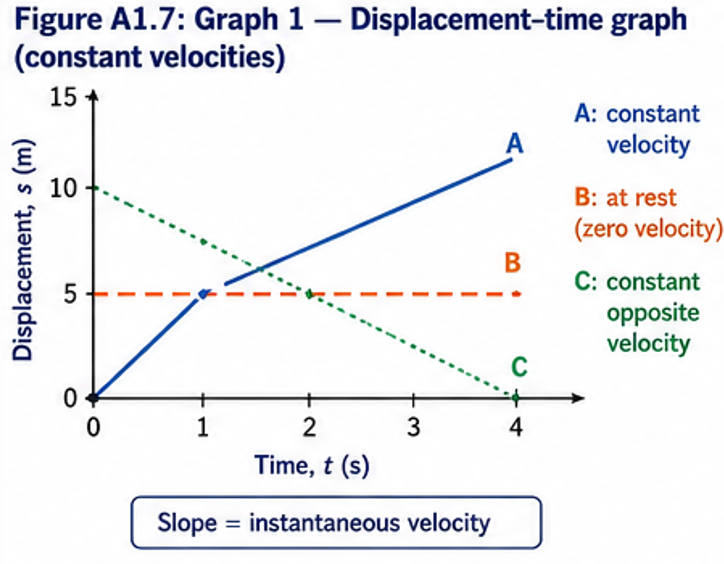
Straight line → constant velocity; curve → changing velocity
Gradient = instantaneous velocity
Velocity–time
Time (s), Velocity (m/s)
Horizontal line → constant acceleration; slope = acceleration
Gradient = acceleration; area under graph = displacement
Acceleration–time
Time (s), Acceleration (m/s²)
Horizontal line for uniform a; area under graph = change in velocity
Area = \(\Delta v\)
Fig 5 — Displacement–time graphs. Line A: constant positive velocity; Line B: stationary; Line C: constant negative velocity (moving back).
(Curved s–t graph for non‑uniform motion would show parabolic shape; linearising \(s \propto t^2\) gives straight line.)
✍️ Worked example – Satellite in circular orbit
1
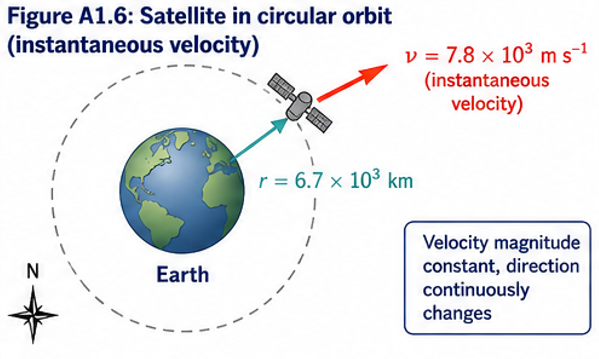
Identify: A satellite moves at constant distance \(6.7\times10^3\,\mathrm{km}\) from Earth’s centre. Each orbit takes 90 min. We need average speed, instantaneous velocity description, and displacement after certain times.
Equation: Average speed \(v = \frac{\text{circumference}}{T}\).
4
Answer: \(v = \frac{2\pi (6.7\times10^6)}{5400} = 7.8\times10^3\,\mathrm{m\,s^{-1}}\). The instantaneous velocity has constant magnitude but direction is always tangent to the circle. After 360 min (4 orbits) displacement = 0 (back to start). After 405 min (4.5 orbits) displacement = \( -6.7\times10^3\,\mathrm{km}\) (opposite side of Earth).
Fig 6 — Satellite instantaneous velocity is tangent to the orbit; displacement measured from Earth’s centre.
🌍 Real-world: GPS and displacement
GPS devices calculate your displacement from the destination, not the distance along roads. They need vector maths (velocity and acceleration) to predict arrival times. Fighter pilots and athletes also use acceleration data to optimise performance.
✓ Examiner tip: Always state the reference point and direction when giving a displacement or velocity vector – marks are lost if direction is omitted.
🚀 HL Extension – Instantaneous acceleration as derivative
In calculus terms, \(a = \frac{dv}{dt}\) and \(v = \frac{ds}{dt}\). For non‑uniform motion, the slope of the velocity–time graph at a point gives instantaneous acceleration. Challenge: If \(v(t) = 5t^2 + 2t\), find \(a(t)\). (Answer: \(a(t) = 10t + 2\,\mathrm{m\,s^{-2}}\).)
⚠️ Trap corner – common mistakes
Misconception
Correct view
"Distance and displacement are the same."
Displacement depends only on start and end points; distance depends on the path taken. They are equal only for straight‑line motion in one direction.
"If speed is constant, velocity is constant."
Velocity can change direction (e.g., circular motion) while speed stays constant → acceleration exists.
"Negative acceleration always means slowing down."
Negative acceleration means velocity is becoming more negative. If velocity is also negative, the object speeds up.
"An object at rest has zero acceleration."
At the top of a thrown ball, instantaneous velocity is zero but acceleration is \(g\) downward (not zero).
⚠️ Most common slip: Confusing distance with displacement in vector calculations. Always include direction (e.g., "300 km northeast") for displacement, and do not use direction for distance.
1. A car travels 10 m north, then 10 m east. What is the magnitude of its displacement?
A 0 m
B 10 m
C 14.1 m
D 20 m
2. Which quantity is a vector?
A Mass
B Velocity
C Temperature
D Speed
3. A runner completes a 200 m lap on a circular track and finishes at the starting line. The runner’s average speed is 8 m s⁻¹. What is the magnitude of the average velocity?
A 0 m s⁻¹
B 8 m s⁻¹
C 16 m s⁻¹
D 200 m s⁻¹
4. A car accelerates from rest at \(2.0\,\mathrm{m\,s^{-2}}\) for 5.0 s. What is its final velocity?
A 2.5 m s⁻¹
B 5.0 m s⁻¹
C 10 m s⁻¹
D 25 m s⁻¹
Practice check — fill in the blanks
Complete the statements:
A is a quantity with only magnitude, whereas a has both magnitude and direction. The average velocity equals total divided by time.
Exam‑style questions
Exam question · Calculate
(a) Define displacement. [1 mark] (b) A student walks 12 m east, then 5 m west. Calculate the total distance travelled and the magnitude of the displacement. [2 marks]
✓ (a) Displacement is the straight‑line distance from a fixed reference point in a specified direction (vector). ✓ (b) Distance = 12 m + 5 m = 17 m. Displacement = 12 m east + 5 m west = 7 m east → magnitude = 7 m.
Exam question · Explain & graph
Sketch a displacement–time graph for an object moving with constant positive velocity for 4 s, then stationary for 2 s. Label axes and indicate the slope. [3 marks]
✓ Axes: time (s) on x, displacement (m) on y. ✓ Line from (0,0) to (4, positive value) – straight upward slope. ✓ Horizontal line from t=4 to t=6 (constant displacement). Slope of first part = velocity (positive constant).
Exam question · Acceleration analysis
A train moving at \(20\,\mathrm{m\,s^{-1}}\) brakes uniformly and stops in 10 s. Calculate (a) its acceleration, (b) the distance travelled during braking. [4 marks]
✓ (a) \(a = (v-u)/t = (0-20)/10 = -2.0\,\mathrm{m\,s^{-2}}\) ✓ (b) average speed \(= (20+0)/2 = 10\,\mathrm{m\,s^{-1}}\); distance \(= 10\times10 = 100\,\mathrm{m}\) ✓ Or use \(s = ut + \frac12 at^2 = 20\times10 + \frac12(-2)(100) = 200 -100 = 100\,\mathrm{m}\).